Annual report meter reading manual
Four criteria, from Sembcorp Marine/Haiting Eleventh Annual Report (2015-2025)
The starting point is a very simple question: How much revenue does Jurong Shipyard make in a year?
Following this question, the answer is peeled off layer by layer, and finally it falls on the four most common types of meter reading errors.
Each category is given symptoms, criteria, examples, and treatment methods. The examples are all marked with the page number of the annual report, and you can go back to the original for review.
quick check
| see what | What to ask first | consequences of misjudgment |
|---|---|---|
| Division numbers are like numbers for a certain shipyard | Has this entity been separately disclosed in the financial statements? | Treating business lines as legal persons is completely wrong in scale |
| Two numbers for the same indicator, very different | Are the two figures on the same page or in two annual reports? | Treat accounting changes as contradictions, or vice versa |
| A total number of "orders on hand" | Hairy or clean; including ship repairing or not | Overestimate by a factor of two, or read execution as shrinking |
| A series of counts that decreases year by year | What is the noun that follows the number in the original text? | Ships and projects are mixed in a sequence without any trace |
This number can only be used if you can answer all four questions. If you cannot answer, you would rather leave it blank.
Card 1 · Existence: Does this number exist in the report?
symptoms
When I see a segment number, I think it corresponds to a certain subsidiary, so I use it as the subsidiary's performance.
"Rigs & Floaters' revenue is 2.428 billion. This is what Jurong does, so Jurong's revenue is 2.428 billion. "
This sentence reads smoothly, but it mixes two levels of accounting into one.
criterion
Is there an annual report?Click this legal entityListed income?
Segment is a business line caliber, and cash-generating unit (CGU) for impairment testing is another caliber. Neither of them is equivalent to a legal entity.
Example
There are a total of eight annual reports from AR2015 to AR2022. Search each one for the co-occurrence of "Jurong Shipyard" and revenue / turnover. not once.
Revenue segment is broken down by business line: Rigs & Floaters, Repairs & Upgrades, Offshore Platforms,
Specialised Shipbuilding.
Impairment is cut by CGU, and there are only two: Singapore CGU and Brazilian CGU (AR2020 page 92).
But Jurong is in the reportNot without entity anchors, just follow the hierarchy:
Jurong Shipyard Pte Ltd (Singapore, 100%)
└─ Subsidiaries of Jurong Shipyard Pte Ltd
└─ Jurong Aracruz Shipyard Ltda (巴西, 100%)
Source: AR2015 page 257 / AR2016 page 274 / AR2018 page 316 / AR2020 page 206 / AR2022 page 202.
This Brazilian shipyard has a scale description (AR2015 page 32): 83 hectares, 1.6 kilometers of coastline,
Including warehouse, mechanical and electrical workshop, hull workshop (painting, sandblasting, pretreatment, segmented assembly);
It is expected to be completed in 2016, and the office building will be opened in 2015.
The first project was the drillship NS Arpoador (built in Singapore), and at the same time eight modules of the FPSO P-68/P-71 were built for Petrobras.
But there is no revenue figure in an annual report.
what to do
Write "the annual report does not disclose income according to the entity" instead of using the number of segments to top it up.
"A certain subsidiary has no independent data" and "This subsidiary has no entity anchor in the report" are two completely different things -
The former is the choice of disclosure caliber, while the latter is really undetectable.
Card 2 · Parallel or restatement: Two numbers appear in the same indicator
symptoms
The same year, the same indicator, two numbers given by two sources are very different.
The first reaction is "data fighting", and the second reaction is to pick a letter.
criterion
Do the two numbers appear on the same page, or in two different annual reports?
The former is two presentations of the same statement; the latter is a restatement caused by changes in accounting standards. The processing methods are opposite.
Example A: Side by side on the same page
2015 (Unit: S$ million):
| caliber | turnover | EBITDA | Operating profit and loss | net income |
|---|---|---|---|---|
| Before provision | 5,134 | 591 | 459 | 384 |
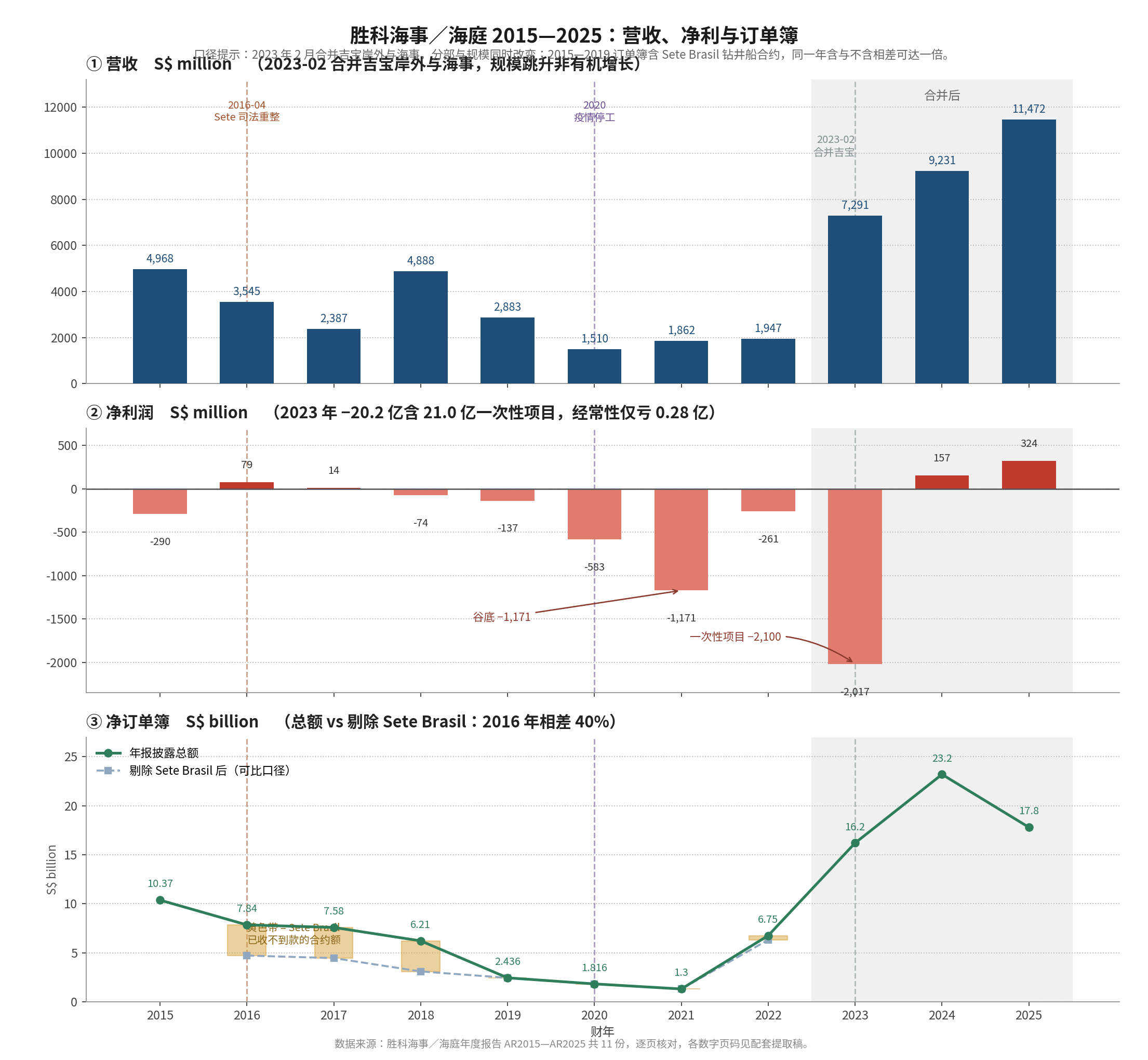
| Report | 4,968 | −18 | −150 | −290 |
The profit went from making 384 million to losing 290 million. The reason is written in the note:
During the year, 609 million was provided for impairment and drilling platform provisions (of which Sete Brasil accounted for 329 million),
Add 192 million share of associate loss, plus impairment of available-for-sale financial assets.
In the five-year financial summary table, these two calibers are marked as 2015 和 2015* (AR2015 p. 35).
Example B: Multi-year report restatement
AR2017 original reported EBITDA 213,369, net profit 14,076;
AR2018 becomes EBITDA after restatement under SFRS(I) 498,626 (2.3x), net profit 260,183 (18x),
Turnover 3,034,767. The restated figures will be used in the five-year charts of each subsequent year.
(AR2020 Page 28: 384 / 499 / 143 / 104 / −380). 2017#.
what to do
Most of the juxtapositions are "pre-provision/reporting standards", and most of the restatements are marked with footnotes (*, #).
When citing both, you must indicate which version it is from, otherwise the numbers will look contradictory.
If you regard the restatement as a contradiction, you will come to the conclusion that "the company changed the numbers"; if you regard the parallelism as an error, you will lose a real difference in caliber.
Card Three · Gross or Net: "Orders in Hand" is a Dangerous Word
symptoms
The order book gives a total number and writes into the article "X billion of orders on hand."
Two days later I saw another version, which was more than twice the difference.
criterion
this amountDeduction of unrecognized income, Including ship repair and modification.Both things can make a 100% difference.
Example A: Gross and net are juxtaposed on the same page
At the end of 2025, the net order book was S$17.841 billion. The gross value given on the same page (page 15 of AR2025) is 39.565 billion.
The difference is 21.7 billion.
Breaking it down to the year of delivery, the problem becomes clearer:
| Delivery year | Number of items | Gross value (millions) | Net worth (millions) | 净/毛 |
|---|---|---|---|---|
| 2026 | 9 | 5,807 | 376 | 6.5% |
| 2027 | 6 | 9,808 | 2,685 | 27.4% |
| 2028 | 3 | 5,786 | 2,606 | 45.0% |
| 2029 | 2 | 7,076 | 3,675 | 51.9% |
| 2030 and beyond | 4 | 11,088 | 8,499 | 76.6% |
| total | 24 | 39,565 | 17,841 | 45.1% |
The 2026 batch of 9 projects has a gross value of 5.807 billion and a net value of only 376 million——差 93.5%,
Since it is nearly completed, most of the revenue has been recognized.
The same word "order book" means completely different things in different delivery years.
Example B: with or without ship repair
End of 2022, original text on page 41 of AR2022:
The Group had a net order book of S$6.75 billion as at end-December 2022.
This consists of S$6.31 billion of projects under execution
(with a total original contract sum of S$7.07 billion)
and S$0.44 billion of ongoing Repairs & Upgrades projects.
6.31 + 0.44 = 6.75.
The bar chart on page 31 of AR2023 for FY2022 is 6,314——Only counted when executing projects.
It looks like it's missing 400 million, but it's actually two calibers.
what to do
When quoting the order book, always indicate three things: whether it includes ship repairs and modifications, whether it is gross or net value, and the end of the period.
If you don't indicate it, readers will definitely think that the data does not match - and this is where writing errors are most likely to be made and where readers are most likely to catch them.
Card Four · Unit: What exactly is this count?
symptoms
A series of counts that decrease year by year seems completely normal and is in line with industry intuition.
criterion
Go back and look at the number in the original articlenoun followed by. It's not a "ship", it's a "project", and the entire sequence is useless.
Example A: The item number is mixed into the ship number sequence
AR2018 report page 6, a number: 296.
Put it into the sequence since 2014, there is no trace:
439 (2014) → 453 → 469 → 390 → 296 → 280 → 146 → 144 → 221
It has been declining all the way, which is in line with the industry intuition in those years.
But the original text is:
296 SHIP REPAIR AND UPGRADE PROJECTS,
INCLUDING 41 LNG CARRIERS AND 10 CRUISE SHIPS
It's the number of projects, not the number of ships. An item number is mixed into a ship number sequence, and no abnormality can be seen on the surface.
Starting from 2023, the entire unit has been changed: 291 / 231 / 185, all marked projects,
And the ship number sequence from 2016 to 2022Not directly connected.
Example B: Discrete readings are not a continuous sequence
There is a ten-year order book chart from 2015 to 2024 on page 47 of AR2024. The ten values corresponding to the column height are roughly
5.1, 6.4, 6.8, 10.5, 11.5, 11.5, 16.2, 17.8, 19.4, 23.2.
However, there are no numerical values marked on the picture, so the height of the column can only be measured visually. These values cannot be reliably paired with years.
what to do
The correct way is not to write it in the form and indicate "return to page 47 of the original PDF".
Guessing a pairing is much more dangerous than leaving it blank - if you leave it blank, the reader will know that there is no count, but if you guess wrong, the reader will not.
Appendix 1: Caliber fracture chronology
The numbers in some years cannot be connected in a straight line. It is not that there is a problem with the data, but that the caliber has been changed.
| breakpoint | change | Influence |
|---|---|---|
| 2016—2019 | The size of the order book is inconsistent from year to year | Comparable sequences excluding Sete are required (AR2020 page 38: 4,709 / 5,225 / 3,088 / 2,436 / 1,816) |
| 2020 起 | Change order book caliber | 1,816 = in execution 1.51 + ship repairs 0.31, not directly comparable to previous years |
| 2023-02-28 | Merger of Keppel Offshore & Marine | The division was changed from business line to Floating Solutions / Fixed Solutions / Repairs & Upgrades, the old Rig Building was split into Floating Solutions, No one-to-one mapping |
| 2023 起 | The unit of ship repair quantity is changed from "ship" to "project" | 291 / 231 / 185 and 2016-2022 ship number sequence cannot be connected |
The acquisition was completed on February 28, 2023 and renamed Haiting.
Revenue jumped from 1.95 billion to 7.29 billion, butIt’s not just the scale that has changed——The definition of division has also changed.
Drawing a continuous partial curve across 2022/2023 is drawing a line that does not exist.
Appendix 2·How does a risk line decay in the report?
Sete Brasil is a Brazilian company. In 2012, it ordered 7 drill ships from this shipyard in Singapore, with a contract value of US$5.6b.
By November 2014, I had paid a total of US$2.70b, and then the payment was stopped.
| time point | what happened | Source |
|---|---|---|
| 2012 | Sign 7 drillships, US$5.6b | AR2017 Page 11 |
| 2014-11 | The supply was discontinued after the accumulated payment was US$2.70b. | AR2016 page 21 |
| 2015 | Provision of S$329m, construction halted, work in progress protected | AR2015 page 19 |
| 2016-04-29 | Sete applies for judicial reorganization | AR2016 |
| 2017-10 | 9-seat Pacific Class 400 sold to Borr Drilling, US$1.3b | AR2017 |
| 2018-11 | Reorganization plan approved by creditors | AR2018 Page 12 |
| 2019-10 | Comprehensive final settlement: retain ownership of 5 vessels, distribute the remaining 2 vessels in proportion to the amount received, terminate arbitration | AR2019 Page 13 |
| 2020 起 | Existing only in notes to contingent liabilities (criminal case) | — |
The visibility of this line on the report is not directly proportional to its true impact.
Number of mentions of "Sete Brasil" in the annual report: 4 times in 2015 → 2016 12 → 2017 13 →
2018 7 → 2019 6 → 1 time per year starting from 2020.
It was mentioned the most during the two years when it was most serious, and then it was transferred to a note—not because it was resolved, but because it didn’t need to be mentioned again according to the guidelines.
There is another operation that cannot be done on the account: The 329 million provision in 2015 is not equal to the 2019 settlement loss.
The former is an accounting provision and the latter is a legal arrangement. The two cannot be subtracted to calculate the "final loss".
The annual report never disclosed the specific amount of the settlement consideration, only the structure of "retaining 5 ships and dividing 2 ships in proportion".
There is no support for any argument of "recovering X billion in settlement".
ending
Four criteria, one sentence each:
- First make sure this number exists. A branch is not a subsidiary, and the group is not a shipyard.
- Look at the position of the two numbers first. Juxtaposition on the same page is a presentation method, and restatements across annual reports are accounting changes.
- Ask each amount if it is gross or net. Including or not including ship repairs, deducting or not deducting unrecognized income, the difference can be doubled.
- Ask about the unit for each count. Ships and projects are blended into one sequence, leaving no trace.
These four items are not accounting knowledge, but reading methods.
The reason for most of the conclusions of "data fights" is not that someone made a mistake, but that no one asked these four questions.
Data source
Sembcorp Marine/Haiting Annual Report AR2015-AR2025, 11 copies in total, checked page by page.
The page number is the physical page order of the PDF, which differs from the printed page number by about 4 pages (previous page).
Key page numbers are marked in the text: AR2015 pages 19, 32, 35, 257; AR2016 pages 21, 274;
AR2017 page 11; AR2018 page 12, 316; AR2019 page 13; AR2020 page 28, 38, 92, 206;
AR2022 pages 41, 194-195, 202; AR2023 pages 24, 31; AR2025 pages 14, 15, 22.
The original copy can be found on the Singapore Exchange Listed Company Disclosure Platform. Please indicate the date of access when citing.
GB/T 7714 citation format example:
Sembcorp Marine Ltd. Annual Report 2015[R]. Singapore: Sembcorp Marine Ltd., 2016.
Seatrium Limited. Annual Report 2025[R]. Singapore: Seatrium Limited, 2026.